Acne, scars & pores
We distinguish active inflammation and the sebum environment from marks already left behind
to choose the treatment your skin needs.
When inflammation leads
to skin damage
Acne is a skin condition that develops when sebum and dead skin cells clog pores and cause inflammation.
Repeated or deep inflammation can lead to red marks, pigmentation, and depressed scars.
Pores can also widen due to sebum production, loss of skin elasticity, and repeated inflammation.
That is why it is important to distinguish active acne from existing scars and pore concerns.
At RE:A CLINIC, we assess the degree of inflammation, the type of scarring, and why pores have enlarged
to determine the right order and method of treatment.

Keys to acne, scar & pore treatment
We assess sebum, inflammation, scar depth, and pore condition together, then choose the treatment that fits your current skin concerns.

Assessing active acne
We examine the type and extent of current acne,
from whiteheads and red pimples to pustular inflammation.
Identifying scar type & depth
We check the shape and depth of depressions and any tethering
to apply the treatment each scar needs.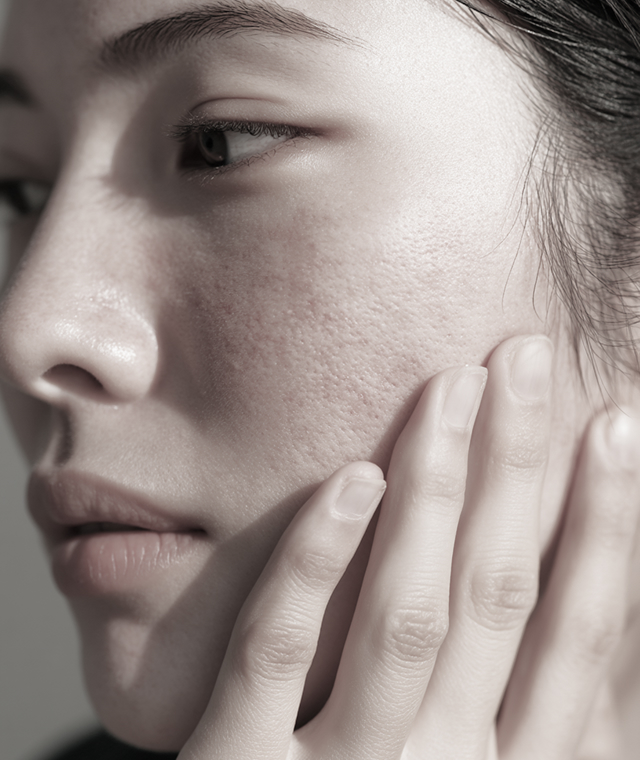
Finding why pores stand out
We look at what makes pores appear enlarged,
such as sebum, loss of elasticity, and repeated inflammation.
Step-by-step treatment
We first control active acne, then move on to marks, scars,
and pores according to your skin condition.
How acne and scars
differ by type
The right treatment and approach depend on the type of acne, the degree of inflammation, and the depth of scarring.
Types of acne
Comedonal acne
Acne that appears as whiteheads or blackheads when sebum and dead skin cells clog pores.
Papular acne
Red, firm bumps that form when clogged pores become inflamed.
Pustular acne
Acne that fills with pus as inflammation progresses and may be painful.
Nodular acne
Large, firm acne that can be felt under the skin as inflammation reaches deeper layers.
Types of acne scars
Ice pick scars
Narrow but deep scars that look like small holes.
Boxcar scars
Square-shaped depressions with relatively sharp edges.
Rolling scars
Scars that make the surface look wavy and uneven due to tethering beneath the skin.
Acne, scar & pore treatments
at RE:A CLINIC
We assess your current skin condition and the characteristics of your acne, scars, and pores, then choose a treatment tailored to your concerns.

Sebum & exfoliation care
Clears clogged pores, excess sebum, and dead skin buildup
to improve skin prone to recurring acne.

Medication
Based on the type of acne and degree of inflammation,
we prescribe topical or oral medication.

Anti-inflammatory injections
Targets red, painful inflammatory acne
to reduce inflammation and discomfort.

Laser & light therapy
We choose devices suited to your sebum, inflammation, and red marks
to treat acne and its lingering marks together.

RF microneedling
Uses microneedles and radiofrequency energy to improve depressed scars,
enlarged pores, and rough texture.

Scar subcision
Releases scar tissue tethered beneath the skin
so depressed areas look less noticeable.

Skin regeneration treatment
Applies ingredients that support recovery around scars and pores
to improve texture and elasticity.

Aftercare precautions
- Do not touch the treated area or squeeze pimples.
- Temporary redness, swelling, flaking, or fine scabs may appear.
- Apply sunscreen when going out and avoid strong sunlight.
- Avoid alcohol, saunas, jjimjilbang (Korean spas), and strenuous exercise on the day of treatment.
- Avoid scrubs, peels, and harsh cosmetics for a while.
Acne, scars & pores
FAQ
- Q Can acne and scars be treated at the same time?
-
A
Depending on your skin, they can be treated together, but if inflammation is severe, it is important to calm the acne first.
Once inflammation subsides, we move on to scar and pore treatment step by step. - Q Can depressed scars disappear in one session?
-
A
Because scars vary in depth and shape, a single treatment may not be enough.
We adjust the devices and number of sessions based on how your skin responds. - Q Can pores disappear completely?
-
A
Pores are a normal part of the skin's structure, so they cannot be removed entirely.
By managing sebum, elasticity, and texture, pores can be made less noticeable. - Q Is it okay to pop pimples myself?
-
A
Forcefully squeezing with your fingers can deepen inflammation and leave pigmentation or scars.
It is best to have extractions done under medical supervision when needed, after checking the inflammation and comedones. - Q Can acne come back after treatment?
-
A
Acne can return due to sebum production, hormones, and lifestyle habits.
Even after treatment, maintenance care suited to your skin and lifestyle adjustments are needed.
